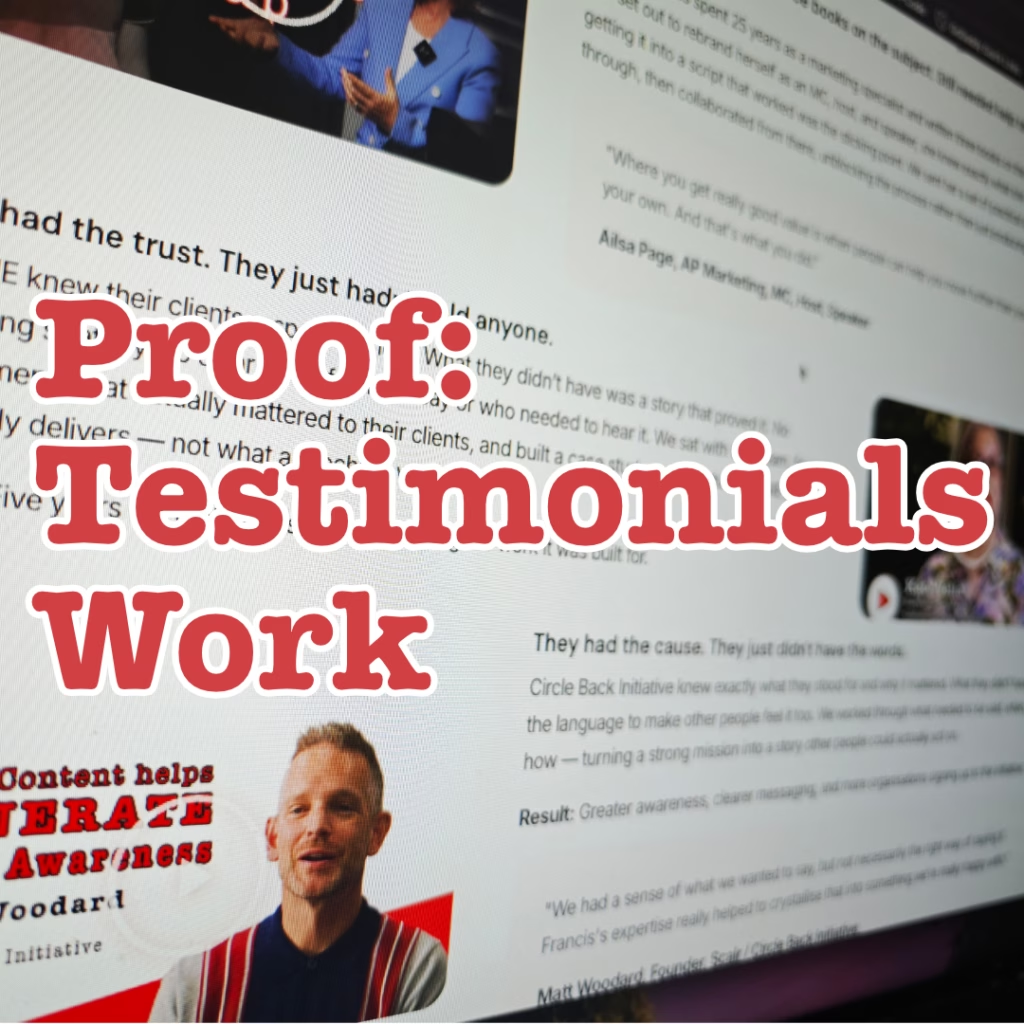
Prove it
Testimonials and case studies cannot be proven to increase conversions, well, at least not in in a single number.
But it is a fair challenge that I always get throughout my years in the industry. There is no directly line that says having two testimonials lift conversions by X% and having five will lift by 2X%. No magic data exists, becaue good testimonials are rarely the only reason someone buys from you. They are only one part of a series of things that lead to a purchase decision.
No ROI so No Point?
No. That’s like saying that no point in reducing sugar in our diets.
Reducing sugar can improve your health outcomes, but only as part of a whole set of things you need to do before you see the benefit. Does that mean that you don’t bother cutting sugar because it is not the miracle that will make you live longer?
Testimonials work in the same way. And just like sugar, you already have a suspicion that testimonials, reviews and case studies are important to have.
So let me help you with some data to support it.
Does the Data Support Testimonials?
73% of business decision-makers rank peer recommendations as their most trusted source of information, and vendor websites came in at 55%.
This comes from a Reddit x SurveyMonkey B2B survey done at the end of 2025 and early 2026. They sruveyed 1,202 U.S. business decision-makers with a margin of error of +/- 3%. It measures where people place their trust when they research into information before purchase.
It doesn’t measure if they actually bought what they researched into, so this evidence is about trust, and not conversion rate.
The same survey asked which content formats are the most useful in their research. Real-user testimonials came out on top, with 37% calling them “very valuable”, ahead of video demos at 32% and analyst reports at 27%.
Bringing these numbers together, I can paint a picture of a B2B customer researching prior to making a decision of who to call becomes clearer: they trust testimonials, especially video testimonials, and it is even more effective if the testimonial is from a peer.
What is a Peer Recommendation?
A peer is someone your prospect trusts because they are judged to be like them. While the survey does not define the term, if we draw from Philip Kotler, a marketing expert that marketing students study; his perception of what a peer is cuts across geographical and cultural boundaries.
A peer is a friend, a family member, a close networking group, a trusted social group (even if it is an online group across cultures and geography), or someone who has gone through a similar experience and circumstance as the prospect.
My opinion on this is that a peer is basically someone you trust because they are like you.
So there is a much better chance of someone deciding in your favour if they recognised the person recommending you is a peer of theirs. Because they can identify with the person giving the testimonial, that recommendation is likely to carry more weight than anything you say about your own features and services.
Trust Cannot be Equated to Conversion… But it Helps
Trusting the information doesn’t mean a prospect will convert. Because there are other factors that you cannot control in their purchase decision that could sway the decision.
For example, when I was looking into installing a Solar Battery System to my home, I received three recommendations from a trusted website, and one from a friend. Of the four, three responded, and only two took proper care and time to explain the options, with one of them actually coming out to my place to look at the installation sites and provide alternatives and suggestions.
With only two top contenders, the decision had to be made. Both offered the same features and services, but only one of them actually came out to have a look, and it did help that that quote was also much closer to my budget
So the decision was swayed ultimately by cost.
My point is that you can do everything right, and still not convert because your prospect’s circumstance just match your competitor a lot more.
Does that mean you should just skip the trust building?
No, because the other 2 recommendations didn’t bother to try to build trust with me, and they were almost immediately dropped from the list of choices.
Make Trust Deliberate, not Accidental
Peer recommendations can reach your ideal clients by accident, and for many businesses, that’s what happens.
They have Google Reviews, maybe a couple of testimonials but they are just scattered assets hoping for prospects to look at them.
If you believe that people buy from people they trust, then building trust with your prospects goes a long way towards making your their provider of choice. A peer recommendation is one way to start the process of building trust with your prospects even before they make a decision to call you.
That’s what the Trust Diagnosis and Trust Strategy are built to do. To help prospects of founder-led businesses, who have build a strong reputation in the industry, and trust with their clients, easily find and see it so that they have the confidence to call you first.
Peer recommendations in the form of testimonials, case studies and reviews are strategy business assets that put you in the shortlist of your prospective clients.
Is this Proof that Testimonials Work?
If you are looking for a definitive number to show cause and effect, then “No”.
But the data shows that having them used strategically can improve the odds in your favour.
If you like to know how the Trust Strategy Framework can stack the odds for you, get in touch about a Trust Diagnosis.