Many businesses collect proof of their capabilities from various sources. A testimonial here, Google reviews there, and maybe a behind-the-scenes social post on occasion.
It all sits on a page somewhere, waiting to be useful.
Philip Kotler, in his book Marketing 4.0, argued we have got it all wrong.
Wait a minute. Who’s Philip Kotler?
He’s been essential reading for any marketing student since probably the 1970s, and has researched and published books ever since, with one of his latest, Marketing 6.0: The Future Is Immersive, published in 2023. He has also been described as the “father of modern marketing.”
So when he says the funnel is missing something, it’s worth a look.
Kotler moved the finish line
Most of us learned a funnel that sounds a little like this: Attention, Interest, Desire, Action. The old AIDA model, an idea usually traced back to advertising pioneer Elias St. Elmo Lewis around 1898.
Kotler redrew that path into five stages of his own: Aware, Appeal, Ask, Act, Advocate. And he put his emphasis on the step the old models never had.
Advocate.
So what’s the big deal? It’s just an extra word. But bear with me, this is more important than it sounds.
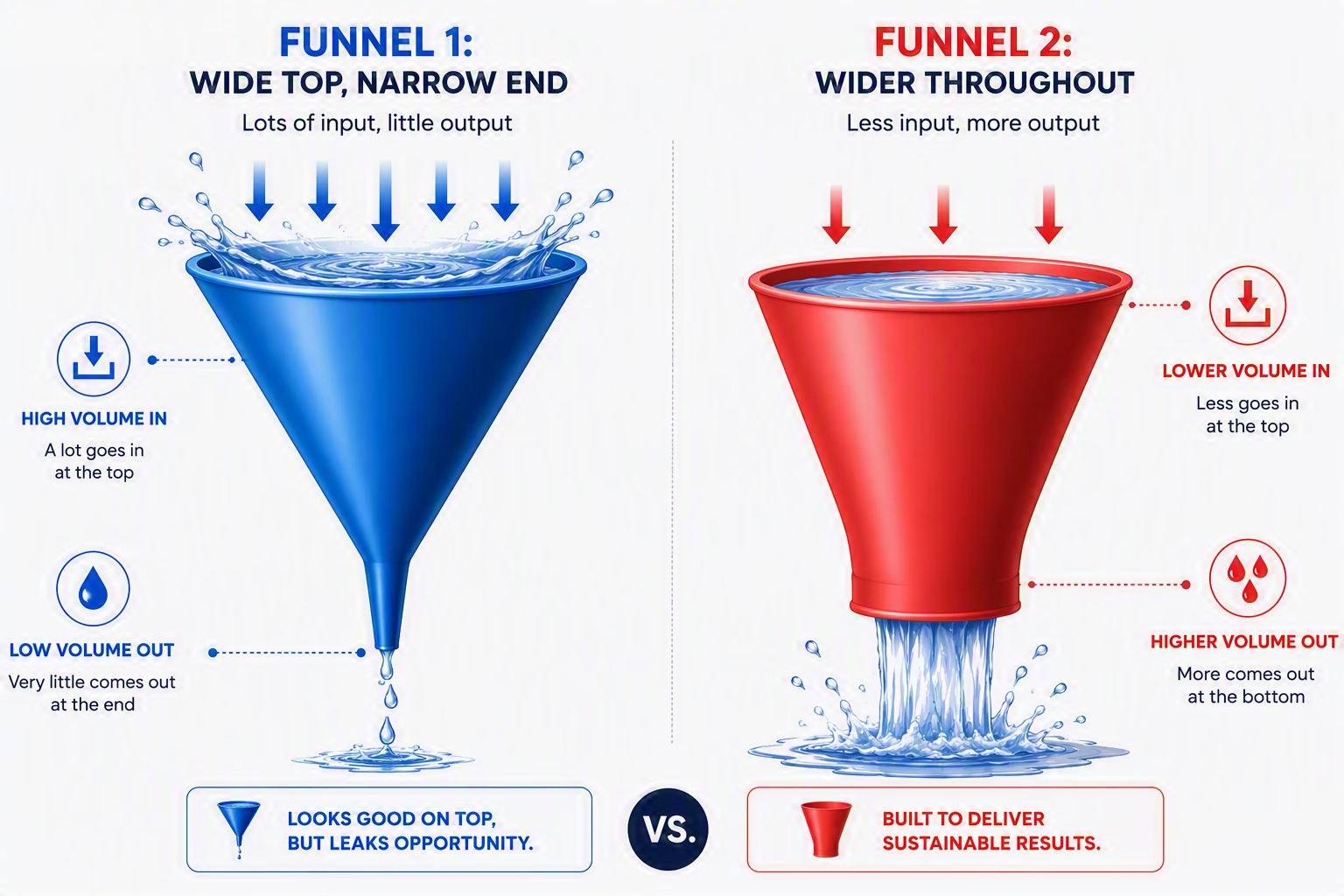
Getting customer advocacy isn’t just one more step at the end of the journey. It is actually the engine that starts the journey for your next customer. To put it simply, getting a good review or a good thank you from your customer isn’t the end. It should be the mechanism that becomes the cornerstone of your marketing.
The Net Promoter Score (NPS) is not enough
In the past decade or so, many businesses have been running the NPS to find out many things. One of which is if people will whole-heartedly recommend the business. In my mind, the NPS is a rear-view mirror looking, measure of how good a business’s reputation is; because that number only looks at the current customer base.
In a report I mentioned before, Roy Morgan’s Risk Labs research gives us some really interesting numbers. Across roughly 600,000 unprompted brand assessments, they found that when Australians say they trust a brand, only 9% credit its reputation as the reason — and when they distrust one, only 6% blame reputation.
Reputation, in other words, barely moves the needle on trust.
So, Yes, the NPS measures if someone is happy to recommend you, but does it really mean that they will when they have to put their own reputation on the line? And what about people who know about you but have never bought from you?
Enter the Brand Advocacy Ratio
Kotler proposed that there needs to be something more, and he calls it the Brand Advocacy Ratio (BAR).
It seeks to discover: of everyone who ever became aware of you, clients or even potential clients, how many went all the way to advocating for you?
It’s not just about looking at your current customers and the people who like you, but the whole room of people who have come to know you.
The BAR is a better metric, I believe, because it measures whether a business has shown enough trust that someone who has only just gotten to know you will trust you enough to buy from you, or recommend you to others, even if they haven’t bought themselves.
To put it simply: NPS is like knowing your reputation. BAR is knowing your trust levels among your prospects.
A BAR reality check
The reality is, Kotler’s methodology for BAR is financially out of reach for many businesses, because it involves creating a marketing survey to discover that ratio. Understanding how aware a group of your target audience is of your brand and business, and how many of them will advocate for the business. That’s the ratio.
However, I didn’t write this article for the top end of town only.
My personal suggestion to find your BAR is really not that expensive or complicated. Start with asking every single person who has reached out to you how they found you.
Ask the question: “How did you hear about us?”
I discovered that a new client of mine found me because of a recommendation from a person I have not met, who asked a third person who knows me. Not because she had worked with me before, but because she saw how I work and trusted me to deliver on what I say I’ll do.
That’s one data point that is a good indication that I have a very good ratio. But one data point is flattering. I need more to confirm.
Why BAR matters
BAR, in my opinion, is a measure of how much trust you are projecting to people who are aware of you.
In my case, as mentioned, the person who recommended me had not worked with me, but was willing to stake her own reputation to recommend me.
It shows that I have not just built a reputation, but showcased how and why someone can trust me.
Trust is the fuel that advocacy needs for it to become the engine that drives your marketing funnel.
Why this should be a comfort
If you’ve run a business on great work, have a strong team of people who will not just work but want your business to thrive, and a book of customers and referral partners, but still feel that the odds are stacked against you in marketing, this should be a source of comfort.
Because you are never going to out-spend the big players on awareness. That game is rigged by budget.
But advocacy isn’t bought. It’s earned, one kept promise at a time. And a trusted business can out-earn a big, well-known one every single day of the week.
Taking a small step back, Kotler built these five A’s of the buyer’s journey not out of thin air, but through his research and observation that buyers now use their own social circles to build a “fortress” against marketing. They screen out brand claims and campaign polish, and only let the voices of people they know through the gate.
In other words, people trust other people they know, or have built a trust relationship with, for recommendations, rather than from polished advertising and brochures alone.
You cannot advertise your way past that wall. You can only be recommended through it.
Sound familiar? Kotler has talked about this since 2016. That social media, friends, and family are the new marketing frontiers.
Which means the businesses that win the next decade won’t be the loudest. They’ll be the most trusted to be referred.
Further reading
- Kotler, P., Kartajaya, H. & Setiawan, I. (2016). Marketing 4.0: Moving from Traditional to Digital. Wiley. The source of the Five A’s, the Brand Advocacy Ratio, and the “fortress” observation.
- Kotler, P., Kartajaya, H. & Setiawan, I. (2023). Marketing 6.0: The Future Is Immersive. Wiley.
- Roy Morgan Risk Labs. Ongoing research into brand trust and distrust in Australia.
- Cialdini, R. Influence: The Psychology of Persuasion. For the social proof principle underneath why any of this works.
Francis Yim has spent over 25 years helping businesses tell the truth about themselves on camera. If you’ve built real trust and it’s sitting idle on a testimonials page, let’s talk about putting it to work.