
Before You Spend More On Marketing
If you’re wondering whether you need more content, better testimonials, stronger case studies, video, social media, or a clearer strategy first, start here. These FAQs explain how Trust Strategy helps uncover, organise and amplify the credibility your business has already earned.
Trust Strategy is the process of identifying where credibility already exists in your business and making that trust more visible to future customers.
It is not about telling you that your business lacks trust.
In reality, many good businesses have already earned trust through referrals, reputation, client results and long-term relationships.
The challenge is that new prospects may not see enough of that trust before they decide whether to contact you.
Trust Strategy helps uncover what already exists, organise it clearly, and turn it into proof that supports your marketing and sales process.
Marketing strategy usually focuses on getting attention. Trust Strategy focuses on what happens after people notice you.
Marketing may look at channels such as social media, SEO, advertising, email, video or content.
Trust Strategy asks a different question:
Once people find you, do they see enough proof to feel confident choosing you?
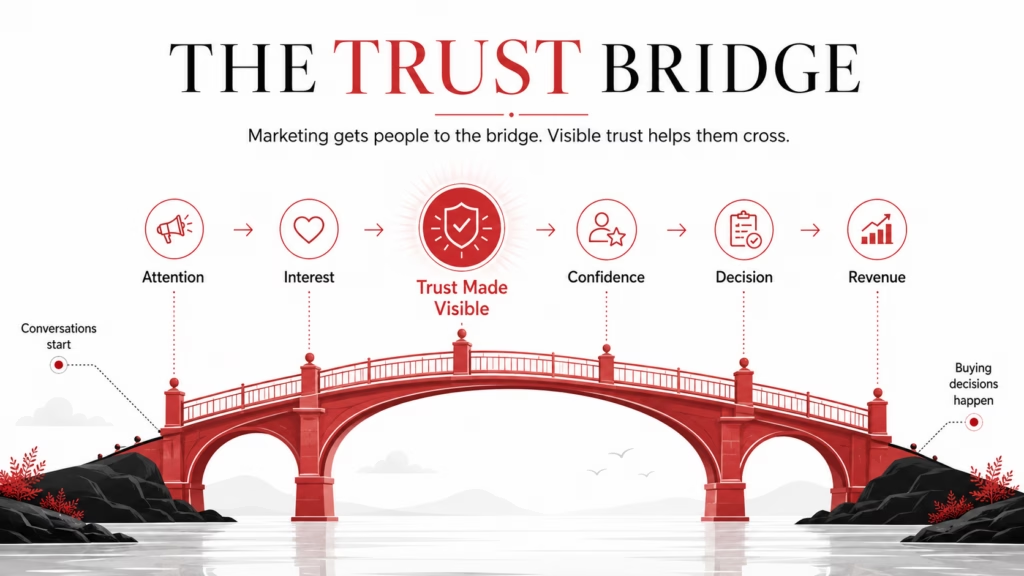
Marketing gets people to the bridge.
Visible trust helps them cross.
If people already know about your business but are not becoming customers, you may not need more marketing first. You may need to make your existing credibility more visible.
Many growing businesses are told to post more content, run ads, get on LinkedIn, improve SEO or make videos.
None of that advice is necessarily wrong.
But before choosing another tactic, it is worth asking:
Where is trust already working in your business, and where are prospects not seeing enough proof?
That is where Trust Strategy begins.
Leads often fail to convert when prospects are interested but have not seen enough proof to feel confident choosing your business.
That does not mean your business lacks credibility.
It may mean the credibility you have already earned is not visible at the right moment in the buyer journey.
At Fantestimonial, we call this the Trust Gap: the space between the trust your business has earned and the trust your next prospect can actually see.
Referrals create trust, because they are based on trust; but they do not always give prospects enough proof to make a confident decision.
Even when someone is referred to you, they may still check your website, Google reviews, social media, case studies, testimonials or LinkedIn profile before reaching out.
If those touchpoints do not reinforce the referral, the prospect may hesitate.
Trust Strategy helps make sure the credibility people hear about you is also visible when they research you.
You can make your business more credible online by showing clear proof of the trust you have already earned; or your story on why people should trust you, when you are just starting out.
This may include testimonials, case studies, customer stories, reviews, founder stories, team stories, client outcomes, industry experience, awards, partnerships and clear explanations of how you work.
The goal is not to make your business look bigger than it is.
The goal is to help prospects see why others already trust you.
You can create more trust before a sales conversation by showing proof, clarity and human connection before someone contacts you.
That might include:
Testimonials that answer buyer concerns.
Case studies that show real outcomes.
Brand stories that explain your philosophy.
Clear website messaging.
Reviews and proof points in the right places.
A visible process that helps people know what happens next.
The goal is to help prospects arrive at the first conversation already feeling reassured.
Before spending more money on marketing, you should understand whether your current issue is attention, trust, or conversion.
If not enough people know you exist, you may need more attention.
If people know you exist but are not choosing you, you may need more visible trust.
A Trust Diagnostic helps identify where credibility is already strong, where proof is hidden, and which marketing activities are most likely to help.
Diagnosis and strategy first.
Tactics second.
The Trust Gap is the space between the trust your business has earned and the trust your next prospect can actually see.
It does not mean people do not trust you.
It means there may be a gap between what your existing clients already know and what new prospects can discover for themselves.
Trust Strategy helps close that gap by making your reputation, proof and customer stories more visible.
The Trust Bridge is a simple way to explain how prospects move from interest to decision.
Attention may get someone to notice you.
Interest may get them to visit your website, ask around or book a conversation.
But confidence is what helps them move forward.
The Trust Bridge helps prospects move from:
“I’m interested.”
to
“I’m confident enough to buy.”
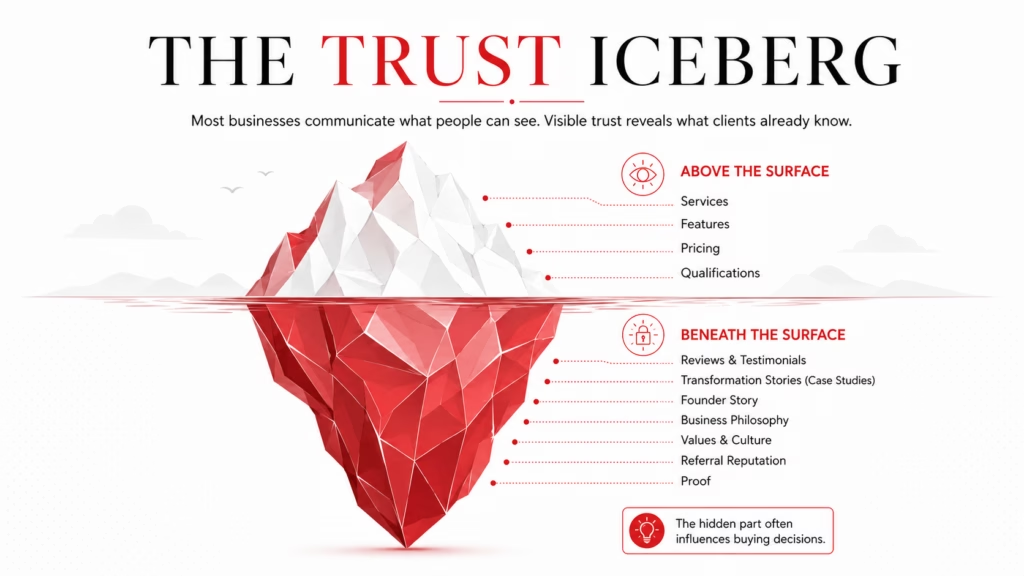
The Trust Iceberg explains why many businesses only show a small part of what makes them trustworthy.
Above the surface, prospects may see:
But beneath the surface are often the things that influence buying decisions:
Trust Strategy helps bring more of that hidden credibility to the surface.
No. Trust Strategy is especially useful for businesses that do not have a full marketing team.
Many growing businesses have marketing handled by the owner, a general manager, an office manager, or one very busy person doing several jobs.
Trust Strategy helps create clarity so that marketing activity becomes more focused, practical and connected to buyer confidence.
However, if you have a Marketing manager or team, we can certainly work with them as well to go through the diagnosis and suggest the best Trust Strategy. They may be able to handle the strategy and execution after the diagnosis report is presented.
If most of your business comes from referrals, that is a strong sign that trust already exists.
The opportunity is to make that trust more scalable.
A referred prospect may still visit your website, check reviews, browse social media or look for case studies before contacting you.
Trust Strategy helps make sure those touchpoints reinforce the referral rather than leaving the prospect uncertain.
No.
Trust Strategy does not necessarily replace your marketing agency or internal marketing person.
It can help guide them.
Many businesses already have someone managing content, social media, websites, ads or email.
Trust Strategy helps clarify what trust needs to be communicated, which proof matters most, and where those assets should appear.
This can make your existing marketing activity more focused and effective, especially in communicating the trust you have already earned with your potential clients.
Yes, and in most cases they should be the ones doing the work.
A Trust Strategy is not a replacement for marketing. Your agency was hired to get you attention, and if they are any good, that is what they are delivering. Attention starts conversations.
The difference is what gets measured. Marketing is usually briefed on reach: impressions, traffic, enquiries at the top of the funnel. Those are the right measures for the job it was hired to do. The questions we ask sit further down. How long does it take a prospect to go from first contact to signed? Where do they go quiet? How many proposals stall at “let me think about it”? How often does someone arrive at a sales meeting still asking questions your website could have answered weeks earlier?
That last one matters more than it looks. Every question a prospect asks you in a meeting is a question your business already answered somewhere, just not anywhere they could see it.
The gap we look at is the space between the trust you have already earned and the trust a stranger can see before they decide to contact you. Referrals, repeat clients, partner relationships, the reason people stay. It is real, and it is usually invisible at the exact moment someone is deciding.
Nobody has been briefed to look for that, because it is not the job anyone was hired to do.
That is what the Trust Diagnosis does. It reads your business the way a first-time prospect does, and maps where earned trust is surfacing and where it is not. What comes out is a plan your existing team can execute. Your web designer knows where the proof belongs. Your SEO specialist knows what the pages need to say. Your agency knows what to prioritise and why.
We do not need to replace anyone. Most of the time I work alongside the specialists a business already has, and the strategy just gives everyone the same brief.
If you want to see the shape of it first, start with the free Trust Audit.
The Trust Audit is a short self-assessment that helps you identify where trust is visible, where proof may be hidden, and where prospects may need more reassurance before choosing you.
It is designed as a quick starting point.
Instead of asking, “What marketing should we do next?” it asks:
Can prospects see enough of the trust we have already earned?
A Trust Diagnostic is the first paid step in the Trust Strategy process.
It is a deeper review of your current website, messaging, testimonials, case studies, reviews, social channels, referral pathways, sales process and existing trust assets.
The goal is to create your Trust Baseline: a clear picture of where trust is already strong, where it is hidden, and what needs to be made more visible.
A marketing audit usually looks at channels, performance, content and campaign activity. A Trust Diagnostic looks at whether prospects can see enough credibility to make a confident decision.
It focuses on questions such as:
What proof already exists?
Where is trust currently visible?
Where are prospects hesitating?
What client stories are missing?
Which trust assets should be created first?
How can credibility be amplified across the buyer journey?
It is less about doing more marketing and more about making better strategic decisions.
There may be some overlap in the process like the discovery of the ideal customer profile, or your business customer persona, but the Audit really focuses on the Pain Point communication.
A Trust Diagnostic reviews the trust signals and proof points currently visible in your business.
This may include:
Website messaging.
Reviews and testimonials.
Case studies.
Customer stories.
Brand story.
Founder story.
Social media presence.
Referral pathways.
Sales conversations.
Proposal or sales assets.
Trust-building opportunities.
You walk away with a clearer understanding of what is already working, what is missing, and what should happen next.
Essentially, we look at every channel you are currently using, and see if it shows people things like testimonials, business ethics, culture… the Why you can trust me signals.
A business should book a Trust Diagnostic when it is getting attention, referrals or enquiries but is unsure why more prospects are not converting.
It is also useful when a business is about to invest in marketing and wants clarity before choosing tactics.
You may be ready for a Trust Diagnostic if:
You are relying heavily on referrals.
Your marketing feels random.
You have happy clients but few strong case studies.
You are unsure what content to create.
You have one marketing person wearing too many hats.
You want to stop guessing what to do next.
You are trying to scale your business and make sure every lead and referral count to your bottomline.
You do not always need a full Trust Diagnostic before creating testimonials or case studies, but you do need strategic clarity.
Before creating a testimonial or case study, it helps to know:
Who is this story for?
What hesitation should it reduce?
What proof does the prospect need?
Where will this asset be used?
How does it support the sales process?
A testimonial without strategy is content.
A testimonial with strategy becomes a Trust Asset. All of these questions are uncovered in the Trust Diagnostic.
A Trust Diagnostic gives you a clearer view of how trust is currently being communicated in your business.
You should walk away with:
A Trust Baseline; i.e. what you are already doing.
Key trust gaps; i.e. why some of the things you are doing may not be working as well.
Hidden proof opportunities.
Quick wins; i.e. some things you can already do really quickly to start improving how your prospects see you.
Recommended trust assets; e.g. a robust Google Review System, Case Studies, and Testimonials, business stories, etc…
Recommended channels to reach your audience, and what you can reduce resources on.
A clearer next step before investing in more marketing activity.
The aim is to reduce confusion and help you make more confident marketing decisions with the lens of someone who needs proof of your trust.
Yes. We put real time and thought into building the Trust Audit, and we’ve chosen to make it complimentary because we want it to be a low-friction first step, not a barrier. There’s no obligation to go further, though we’d encourage a conversation with us about what it uncovers.
It is not a full strategy.
It is a starting point.
If the audit reveals that trust is not being communicated clearly enough, the next step is usually a Trust Diagnostic.
Trust Assets are pieces of content, communication or proof that help prospects believe your business can help them.
They may include:
Testimonials.
Case studies.
Customer stories.
Brand stories.
Founder stories.
Reviews.
Website proof sections.
Sales assets.
Social proof content.
Video can be one of the formats, but the real asset is the trust being communicated, across different channels and using different formats to optimise for different user needs.
Testimonials help improve sales conversion by allowing prospects to hear from like minded people or businesses who have already trusted your business.
A strong testimonial does more than say, “They were great.”
It should match your ideal client’s questions and problems through stories that go through:
What problem did the client have?
Why did they choose you?
What was the experience like?
What changed after working with you?
Why would they recommend you?
This kind of proof can reduce hesitation and increase confidence.
A testimonial usually focuses on a client’s experience and a single problem and their recommendation. A case study tells a deeper transformation story.
A testimonial builds reassurance.
A case study builds confidence.
A testimonial may say:
“This business was great to work with.”
A case study shows:
Here was the problem, and various pain points.
Here was the decision.
Here was the process.
Here was the outcome, and the partnership is formed between the 2 businesses.
Both are valuable Trust Assets, but they play different roles in the buyer journey.
Case studies help prospects trust your business by showing how you have solved real problems for real clients.
They are especially useful when your service is complex, high-value, relationship-based or difficult to compare.
A good case study helps prospects see:
The situation before.
The challenge.
The decision-making process.
The solution.
The result.
The human experience.
This gives future buyers more confidence than a simple claim.
A brand story helps prospects understand the people, values and philosophy behind your business.
It matters because buyers are not only asking:
“Can this business do the job?”
They are also asking:
“Do I like the way they operate?”
“Do they understand people like me?”
“Do their values align with mine?”
“Can I picture myself working with them?”
A strong brand story helps reveal the human side of your business. This more than just talking about, for example, being a sustainable business, but showing how you are sustainable, and why you want to be sustainable.
You may need video testimonials, written case studies, or both depending on your buyer journey and how prospects make decisions.
Video testimonials are powerful for emotion, connection and authenticity.
Written case studies are useful for detail, search visibility, sales follow-up and decision-makers who want to review information carefully. And it also improves SEO and AEO if done correctly.
Often, the best approach is to capture one strong customer story and repurpose it into several Trust Assets.
Yes. Fantestimonial helps identify which Trust Assets are most useful before creating them.
Not every business needs more video.
Not every business needs more social media.
Not every business needs a long case study immediately.
The right assets depend on your audience, your offer, your buyer hesitation points and where trust needs to be made more visible.
And that’s why we always recommend the Trust Diagnostic before we start.
Yes, Trust Strategy can help make social media more purposeful by clarifying what proof, stories and trust signals should be shared.
Not every business needs to have dancing staff, or talking heads.
It’s about what you need to communicate and to whom and using which channel.
So not every business needs to be on every platform.
Some businesses need LinkedIn.
Some need Instagram.
Some need Google Reviews, YouTube, email, referral partners or better website proof.
The right channel depends on where your prospects look for reassurance before making a decision.
A testimonial or case study video showcases real clients sharing their experiences and the positive impact your services or products have had on their business or life. These videos are powerful marketing tools that build trust and credibility with potential customers.
Just think of how influencer marketing has taken over FMCG. That does not mean that as a car parts manufacturer or a bookkeeping business needs to have influencers. But people listen to other people, and decide whether to trust you.
These videos work 24/7 on your website, or on social channels where you can be discovered. So in other words, the ROI can be felt 7 years after the testimonial video was made.
Testimonial videos allow potential clients to hear directly from satisfied customers, creating a level of trust that text-based testimonials can’t match in terms of showing human emotions and authenticity. When done well, they address specific customer pain points and provide proof that someone else has benefited from working with you. That can improve conversion rates and strengthen the signals that you can be trusted. The key is identifying where your prospects most need to see these testimonials in order to make that purchase decision.
From a cost perspective, if you invest in 1 Video Case Study it can actually generate at least 2 or more videos that can be used in various marketing strategies, platforms and funnels.
Case studies can be spun off to multiple video assets. So you get multiple videos for the price of 1 production.
All this time, you can be as hands-on or hands-off as needed.
We believe so. We offer various packages to catering to businesses at different stages of growth.
We work within your budget to create a product that meets your marketing objectives without breaking the bank.
And if you want to film it yourself, but have no idea on how to edit it, we can help you with a much simpler package, starting from $79/video.
The timeline varies based on the project’s complexity, but typically, a testimonial video can be completed in 4-6 weeks from planning to delivery. We’ll provide a more accurate timeline during our initial consultation. However, we have an accelerated package that can deliver your testimonials in as little as 2 weeks.
We’re experienced in working with individuals who are new to being on camera. Our team guides them through the process, ensuring they feel comfortable and prepared, resulting in a genuine and engaging testimonial.
There is also an option of just a Voice only Testimonial interview, where we will then use the interviewee’s voice as the sound track to an animated testimonial.
Oh, and for the time poor or remote clients, we also offer online testimonial recordings, that are run like a video call, and they can be in the comfort of their own homes or offices.
During the planning phase, we dive deep into understanding your brand’s voice, visual style, and key messages. This ensures that the testimonial video not only aligns with but also enhances your brand identity.
We will even suggest the best type of customer to pick and the style of testimonial video that will best suit your marketing and brand strategy.
Absolutely. Testimonial and Case Study videos are versatile and can be used on your website, social media platforms, email marketing campaigns, and even Sales Marketing Funnels. We can also advise on the best strategies for video distribution to maximise its impact.
In fact that’s what we usually do first before embarking on making the video.
We will consider what your needs are across the channels, and propose a suite of videos for the various platforms. For example, the main testimonial or case study can be longer in nature, and because of the limitations of platforms like Instagram, we will help you re-edit into shorter videos, and also changing the video layout to a portrait format for TikTok etc.
The ROI of a testimonial video cannot always be measured cleanly, and anyone who promises you a precise figure is guessing. A testimonial rarely closes a sale on its own. It sits in the middle of a decision that also involves your website, a referral, a phone call and a proposal. Attributing the sale to one asset in that chain is guesswork.
What you can measure is longevity and use. Some of our clients’ testimonial videos have been working on their websites for five and seven years, still sent with proposals, still watched before the first call. A video that keeps earning for that long has paid for itself many times over. Cost divided by years of active service is a more honest number than any attribution model.
If you’re a marketing manager who needs to show ROI to decision-makers, here’s a simple approach that gives you real, defensible measurement rather than a made-up percentage:
You won’t get a lab-perfect ROI figure. What you’ll get is a break-even you can defend and a growing pile of clients telling you the video was in the room when they decided. For most decision-makers, that’s a far more honest case than any 300% claim.
Getting started is easy! Contact us for a no-obligation consultation to discuss your goals and how our testimonial video services can help achieve them. We’re here to guide you every step of the way.
Sometimes the best way to answer “does this actually work?” is to let a client answer it for you.
This is a testimonial from TierONE Capital, a financial services company working with high-net-worth individuals and property developers. In it, they talk about how Fantestimonial helped them produce their own case study video, and what that process looked like from their side.
It was filmed during the COVID pandemic, which made coordinating the key interviewees genuinely challenging. But the result speaks for itself: A video that has been working hard on their website for over 5 years.
If you’re still on the fence about whether video testimonials and case studies are worth the investment, this might be the thing that tips you over.
It’s a genuine concern, especially for the many small businesses I speak to. So here’s my take.
You may not need a full case study or testimonial production right now. The reason you’re here is that you know you need to show prospective clients you have happy clients who trust you and are willing to share their experience.
There are other, more cost-effective ways to show that. But to spend well, you first need to know where that proof matters most.
So here’s a suggestion: take the free Trust Audit to start working out where you’ve already earned trust and where it needs to be seen. If you want help turning that into a plan, the Trust Diagnostic is the next step, a structured way to know where you stand and where trust signals will do the most work, so your marketing budget goes where it counts.
I’m happy to hear the business is doing well and you’re busy. That’s a good sign.
In a marketing business like ours, we get the same highs and lows, and the hardest thing to get right is filling the pipeline while we’re flat out delivering, so that when the busy season ends, the cashflow doesn’t drop off with it.
The catch is that marketing has a lag. Most of it takes a couple of months to show results, so it has to start before you need those results, not when you finally have a spare afternoon.
That’s why we make it easy to hand part of it off. We also help you spend your effort where it actually counts by first working out where you need the most help. That’s what the Trust Diagnostic is for.
And if all you need is a video made, we can take over managing the full production while keeping you in the loop, so you can do what you do best, running your business, while we do what we do best, making videos that meet your marketing needs.
Fair call.
Do think about the last few purchases you made of substantial value. A new mobile phone, a new car, or the mechanic to service your car…
How did you decide? Did you just buy the first one available? Or hire the first person who’s happy to help you at the lowest price?
Or did you get it because you heard, or read, or researched to find one of good reputation or quality?
How often do you read a testimonial or review before you purchased or hired?
Whether you are a B2B or B2C business, your customers engage with you, usually, based on 2 things: 1) if they already have an established relationship with you; 2) If they don’t, then someone else has recommended your business.
Testimonials are the recommendations your existing customers, who are likely from your target market, give your prospects. They provide the assurance that you and your business are credible, trustworthy, and great to work with.
They provide the human connection between your brand, product or service, and existing and potential customers.
That is why many businesses are constantly encouraging their customers to rate them on Google Reviews or on their own website.
Video testimonials just supercharge testimonials by providing a face to the story.
TierONE Capital, who work with high-net-worth clients, put it plainly, “…You need to have it. It adds legitimacy to your business. So even though we don’t market to the general public, the people that we do deal with are high-net-worth people. They are going to Google you.”
Testimonials provides a level of comfort in the purchase cycle.
That is a justifiable question, considering that you will be investing in these videos, you want to make sure there is a good ROI.
That is also our goal for you, because if you are not successful, then we haven’t done our jobs right.
That is why we will always start by understanding you, your business, your customer’s pain points, and why they want to buy from you.
From there we will suggest the messages and focus when creating the testimonials or case studies. And we will also suggest that you will want to run an A/B test on the various messages if you are not sure what sticks, to find the most effective message or video.
Once you get that result, we can then help you tweak the existing videos, or use the information to make more testimonial videos with the messages that work.
We do not offer a magic bullet to solve all your marketing issues, but we offer a powerful tracking and iterative system to tackle it, and will work with you to hit the target… market.
What is your Unique Selling Point (USP)?
What makes your business stand out from your competitors?
Testimonial and Case Study Videos are very good at showing your USP, with real stories from happy clients telling how your business has made their life or business better.
Your Testimonial Videos are proof that your USP works, because it has solved the pain points of your customers and they are happy to share it with everyone.
These are real stories, and real people engaging with your potential customers, creating an emotional connection between your business and your customers.
So Testimonial Videos will help you stand out from the crowd because you have an outstanding business, you just need to show it.
We certainly can, and will still provide the full service of helping you prepare your customers for the testimonials.
From our experience, you want to curate the information from your testimonials as much as possible to optimise the message. So even on a video call you want to ensure that the customer is prepared to provide great answers, and as much as possible, in a space that looks good as well. We have a short Video Tip on how to improve Self-Filmed Video Testimonials Here.
What’s more, we are also offering a service where we can just record voice interviews from your customers, and then use animation to bring their story to life.
This style of animated testimonials can be visually interesting, and can be used for customers who may have a great story to tell, but are put off by having to be on camera or cannot be on camera due to their location.
The quality of self recordings and video call testimonials is hard to control. All we can do is mitigate or reduce the risk. We have a short video here on how you can improve Self-Filmed Video testimonials.
For example, we offer animated Testimonials which reduce the risk of visual quality of self recorded testimonials, and online video call testimonials.
We also prepare your customers by not just talking through the question and answers, but also suggesting locations for the interview to get the best result from their equipment and location.
Below is an example of a video we produced for the Sleep Health Foundation, with Creativa.com.au as the creative agency, that had to have their experts located all over Australia talking about the Sleep Health Foundation on their Anniversary event.
While it’s not a testimonial, it is an example of how we can treat self recorded interviews to give it higher production values and make it look nice.
That’s a common place to land, and it’s fine not to know yet. If your question is “where is my business losing trust, and what should I do about it,” start with the Trust Strategy side. If you already know you want a testimonial or case study video made, a video quote is the quicker path.
Not sure which? Tell us what you’re trying to achieve and we’ll point you the right way, no pressure either way.
Book a time to have a chat with us.