Who doesn’t love watching an awesome Rube Goldberg machine?
You know the ones. A marble drops, it knocks a domino, the domino tips a lever, the lever fires a spring, and twenty absurd steps later, a piece of toast pops up. They’re delightful precisely because they shouldn’t work, and then they do.
(If you’re not sure what a Rube Goldberg machine is, check out this amazing video from OK Go; the song’s really good too.)
Here’s a question worth sitting with: is your sales funnel a slide to the end, or is it a Rube Goldberg machine?
And here’s a better one. Let’s break physics for a second and ask: is your sales funnel a perpetual Rube Goldberg machine? One that doesn’t stop when the toast pops up, but resets itself and runs again?
That second question isn’t just a fun thought experiment. It’s close to what Philip Kotler, the man who wrote the textbook on marketing, actually proposed in his book Marketing 4.0 (co-authored with Hermawan Kartajaya and Iwan Setiawan). Kotler’s argument was that the traditional funnel, the one that narrows from awareness down to a single purchase and stops, no longer describes how people actually decide to buy something. In a connected world, the old finish line, the purchase, isn’t really the end of the journey. It’s the middle of one.
The Old Model Had a Finish Line. This One Doesn’t.
For decades, marketers thought in terms of AIDA: Attention, Interest, Desire, Action. It’s a funnel. Wide at the top, narrow at the bottom, and once someone acts, the model’s job is done.
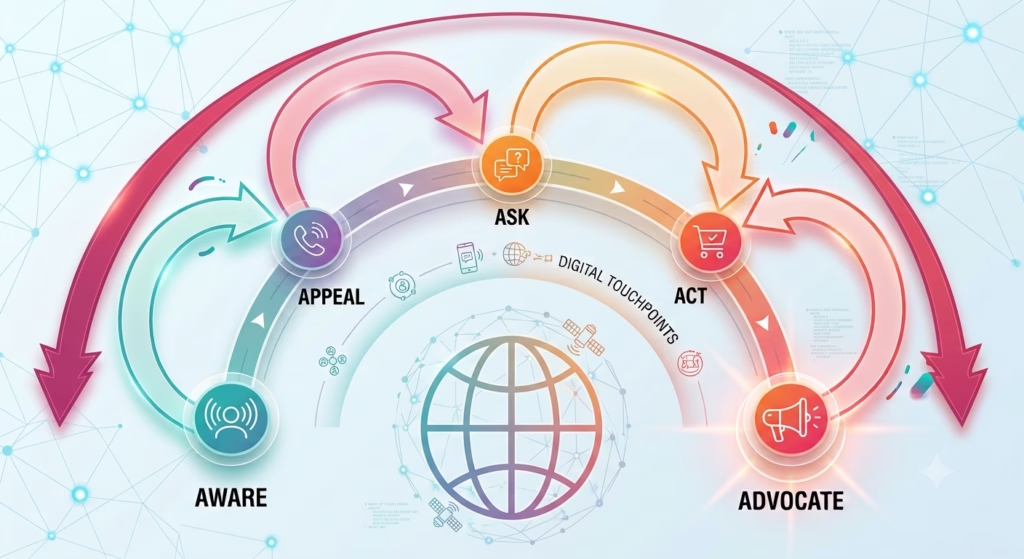
Kotler’s replacement is the 5 A’s: Aware, Appeal, Ask, Act, Advocate. On the surface, it looks like a longer version of the same funnel. The real shift is in what happens after Act.
In the old model, a completed sale was the end of the story. In the 5 A’s model, it’s the start of the next one; because what a customer does after they buy is often more powerful than the purchase itself.
Walking Through the Five A’s
Aware is the entry point. This is when a prospect first has a brand or business register in their mind, whether from an ad, a search result, a conversation, or simply walking past a shopfront.
Appeal is what happens next. Of all the businesses someone becomes aware of, only a handful actually stand out enough to be considered further. Something about the business has to earn a second look.
Ask is the research stage. This is where a prospect goes looking for reassurance: reading reviews, checking a website, asking people they trust. It’s the stage where trust either gets confirmed or quietly falls apart.
Act is the decision. The purchase, the booking, the signed contract.
Advocate is where most funnels used to stop looking. It’s what a customer does after the purchase: whether they stay quiet, or whether they tell someone else.
The Part Most Businesses Miss
Here’s the takeaway that changed how I think about all of this: Advocacy isn’t the end of the journey. It’s the mechanism that starts the next one.
Kotler’s insight is that Advocacy doesn’t just sit at the end of one customer’s journey. It becomes the Awareness stage for the next prospect. A recommendation from someone you trust, a review read at exactly the right moment, a friend who mentions a business unprompted; that’s Advocacy quietly doing the job that used to belong to advertising.
And it doesn’t stop at Awareness. Advocacy feeds every stage in between too. When a prospect is deciding whether a business Appeals to them, an existing customer’s story often does more of that convincing than the business’s own marketing. And when a prospect reaches the Ask stage, genuine advocates, people who’ve lived through the exact same questions, provide answers a brochure never could.
That’s the loop. Not a funnel that narrows to a point and stops, but an engine that feeds itself, generating the next cycle from the output of the last one.
The Journey Isn’t a Straight Line
Here’s another part of Kotler’s thinking worth sitting with: the path from Aware to Act isn’t linear either.
Think back on your last significant purchase. Not groceries; something more substantial. A phone, a car, or something for your business. You probably bounced between Aware, Appeal and Ask more than once as you weighed up your shortlist. And I’d bet that, consciously or not, what you were really doing was looking for a reason to trust one of them enough to act.
Even when price is a factor, it’s often the comfort and confidence built up during that research that decides who actually gets the sale.
What This Actually Means for a Business
Strip away the textbook language, and here’s what it comes down to: how do you give your prospects the comfort, confidence, and trust to buy from you?
Plenty of businesses focus almost entirely on getting traffic, leads and attention, on the belief that the more people who get to know them, the better their chance of landing the sale. A lot of marketers will tell you it’s a numbers game.
But what if you could stack the odds in your favour instead? That’s the brilliance in Kotler’s insight. You can.
Advocacy from your current clients, your referral partners, the way you run your business, and what you actually stand for, is the engine that feeds back into the Awareness and Appeal stages for your next customer. It answers the Asks, the real questions your prospects are trying to solve, before they’ve even had to say them out loud.
That small push at each step of the journey, and the loop back into the next one, stacks the odds in your favour.
So yes, it’s still a numbers game. Just not the one most people think. It’s not about getting a thousand people to the top of the funnel and hoping enough of them take the dive. It’s about improving the odds at every step along the way, so more of them move to Act, and eventually become advocates for the next person looking for you.
Why This Sits at the Centre of the Trust Strategy Framework
This is exactly why Advocacy became the cornerstone of how I approach marketing in the Trust Strategy Framework. It isn’t just about producing testimonials or collecting reviews for their own sake. It’s about deliberately building and managing the advocacy process, so that it feeds back into your sales funnel, or buyer’s journey, and keeps generating new ones.
Most businesses already have the raw material for this. What’s usually missing isn’t the trust itself, it’s a deliberate way of putting that trust to work, stage by stage, so it keeps the machine running instead of stopping the moment a single sale is made.
Can the Trust Strategy Framework help your business? If you’ve been putting time and resources into marketing without getting the results you’re hoping for, chances are you don’t need to reinvent the wheel. You just need to find where your wheel has a leak, and fix it. That’s what this framework is built to do.
If you want to know more, book in a Trust Strategy Call with me. Or if you’d rather see where your business stands right now with a simple ten-minute self-audit, click here to start your free Trust Audit.