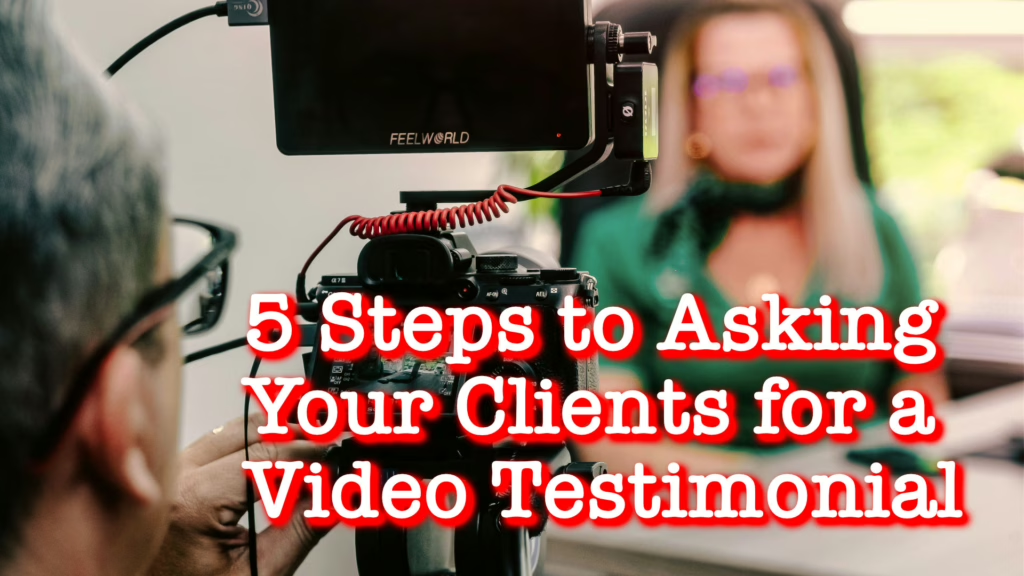
Asking your client for a testimonial can feel like asking someone for a favour… or a date.
After all, they have already engaged your business. They’re already happily working with you and have had great results.
Why spoil a good thing now?
I know that somewhere at the back of your mind there may also be that nagging feeling… you don’t want to impose. Or worse still, you fear rejection.
So how do you ask your clients for a testimonial, be it video or written, and get a “Yes” almost 100% of the time?
Let’s start with the part most people miss.
If you want to watch rather than read… Here’s how I used what I’ve presented below in a practical video; if not, just read on:
The Mindset Shift When Asking for Testimonials
There must be a mindset shift when asking your clients for testimonials.
The shift is this:
A testimonial is simply feedback.
If you are not constantly trying to get feedback to improve your offerings, then stop reading this article…. Because I can’t help you.
But if you are in the business of growth, improvement and innovation, then feedback from existing customers is critical to future success.
When you frame getting testimonials as getting feedback, you’ve already won most of the battle.
Because whether your client says yes or no, you now have the opportunity to dig deeper and discover the “why” behind their answer.
And that “why” is incredibly valuable.
With that in mind (no pun intended), let’s talk about timing.
When Is the Best Time to Ask for a Testimonial?
Timing does play a part.
1. Ask When Results Are Clear
The most obvious time to ask for a testimonial is when the results are clearly visible; usually at the conclusion of a project or end of a service cycle.
That’s when your customer is happy — maybe even over the moon.
As the idiom goes, strike while the iron is hot.
At this point:
- They feel good about the results
- They can clearly articulate the transformation
- They are more willing to share their good results
That’s a natural window.
2. What If You Missed the Perfect Moment?
It happens. And that’s from personal experience
When we completed a Case Testimonial for a client during the 2020 lockdown in Melbourne, it was impossible to film a testimonial at the time. And when restrictions lifted, we simply didn’t pursue it.
Five years later, we decided to reach out to the client, just to check in.
They gave positive feedback about the experience and the results AND they remembered our service fondly.
So we asked if they would be happy to provide a video testimonial.
They said yes.
So, here’s the takeaway:
If the relationship was strong and the results were real, it’s never “too late.” There is some techniques to how you ask after such a long time that I will go into further down.
3. Ask When They Have Capacity
Even if a client is happy, they may not have time to oblige. So asking for a video testimonial from your client requires some situational awareness on your part.
If they are facing deadline pressures or major workload issues, the answer may be no — not because they don’t value you, but because they don’t have the headspace to do it.
Being sensitive to their situation helps.
However getting a provisional “Yes” is a great start, because you can look at scheduling it for a later date.
So how do you actually ask your client for a video testimonial?
How Do You Ask for a Video Testimonial?
The simple answer?
Just ask.
“Hey, I’m really happy for you, with the results you’ve achieved. By the way, are you happy to do a video testimonial for me?”
There is absolutely nothing wrong with this approach — especially when your client is coming off a high after a success.
But it’s not always that simple, is it?
So here’s a technique I’ve used successfully — even five years after completing a project.
A 3-Step Approach to Asking for a Testimonial
Step One: The Recap
Start with a catch-up meeting.
Approach it as a discovery and feedback session. You genuinely want to find out what’s working and what isn’t.
Make sure they understand that their feedback is valuable.
During this conversation, recap:
- Where they were before working with you
- What challenges they faced
- What changed
- The results they achieved
This helps them relive the journey. It reminds them of the partnership and the outcome.
Of course you should ask about what did not work as well, and their opinions on any improvements.
And depending on the situation, you may even ask for permission to record the session for internal review.
Sometimes this happens over multiple catch-ups. Sometimes it happens in one.
Keep it conversational, even casual.
BTW, these questions are also similar to the ones you should be asking when actually filming the video testimonial. If you want to find out more, here’s a story about the 5 key questions to get a powerful Emotive Testimonial
Step Two: The Lead-Up
Now that your client has warmed up and reflected on the value you had provided, you gently move toward the testimonial.
You lead with these question:
- “Besides the tangible results, how did getting the results make you feel?” (You want to have a positive feeling here)
- “Are you happy for me to use what you’ve shared as a case study in my marketing?”
- OR “Would you be comfortable if I shared your story to help other businesses benefit the same way?”
Notice what’s happening here, you are just asking if you can use what they have already provided.
Most people are happy to contribute — especially if it doesn’t inconvenience them.
And when they see that their story could genuinely help you or others, resistance drops.
Step Three: The Ask
If they’ve agreed to sharing their story, the final ask becomes natural. OH… But note that this may not need to be immediately after Step Two.
Going back to my experience, because I had recorded the audio of our feedback session; I put together a write up and an Audio edit of what I wanted to do with what they had told me. So they could see and hear what I wanted to use. Then I asked:
“Would you be happy to share what you’ve told me in a short video testimonial? I can use the audio that I have already recorded, or I can come back to record a video with you.”
Then reduce friction. Explain that:
- It can be simple shoot. I could use my phone to do it, or get a videographer to shoot it professionally so that their business and mine will look good on screen.
- It won’t take long, at most an hour.
- You’ll handle the process and there is nothing else they need to do.
By giving the option that it can be filmed casually on a phone, tells them that it is no fuss, and not daunting. Then offering it to be done professionally and explaining that it will make both our business look fantastic.
And this is important:
A testimonial isn’t just about promoting you.
It’s also free publicity for them.
In every strong testimonial, your client’s story is central. Your product or service is simply the vehicle that helped them succeed.
They would want their business to look good, so getting it done well is probably a no-brainer. And by doing so, they will be showcasing their business, and supporting yous. There’s very little reason to say no.
That’s the 3 step approach that I use successfully.
How to Almost Always Get a “Yes” for a Testimonial
Let’s simplify everything:
- Change your mindset — it’s feedback, not a favour.
- Find the right opportunity to ask for it and make it convenient for them
- Start with a genuine feedback conversation with your client
- Ask permission to use their story before asking for a your marketing.
- Lead them to doing a Video Testimonial
- Show them how it benefits their business too.
When you make your clients feel valued, respected and minimally inconvenienced, saying “Yes” becomes the easy option.
Not because you pushed them.
But because you approached it the right way.
Frequently Asked Questions About Asking for Testimonials
Start by asking for feedback about their experience. When they share positive insights, ask if you may use their story in your marketing. This naturally leads into a testimonial request without pressure.
The best time is immediately after your client experiences clear results. However, you can also ask later if the relationship remains strong and the impact is still meaningful.
Written testimonials are easier to obtain. Video testimonials build higher trust because viewers can see authenticity and emotion. If possible, offer both options.
In general, video testimonials are the most effective because it is like someone giving your business a direct and genuine referral.
If asking for testimonials has felt uncomfortable for you, you’re not alone.
But when you approach it as a conversation about growth — not a favour — it becomes much less awkward.
And sometimes, getting that “Yes” is simply about asking in a way that makes everyone feel good about it.
Fantestimonial has a “Done-for-you” service where we will do everything from asking your clients on your behalf, preparing them for the interview, and filming and editing the interview.
To find out more, book a time to have a no-obligation chat.