Or Are You Just Fishing in the Ocean?
Most business owners I speak to aren’t short on marketing tools.
They have a website. Some have a brochure. Maybe a social media presence. A few are running Google or Meta ads. Some are doing all of the above.
And yet… many of them aren’t getting the leads they are expecting. The sales pipeline feels random. Some months are great. Others are inexplicably quiet. And for those who have active paid Ads, if they stop spending on ads, you can almost hear the silence.
If that sounds like you… here’s what I think is actually going on.
The Ocean Problem
Let’s talk about paid ads for a second. While I personally have misgivings about spending on Ads… Google Ads. Meta Ads. They can work.
Plenty of businesses have built entire sales pipelines on the back of them. The model is simple: you put the juiciest worm on the hook, you cast it into the ocean, and you wait for the hungriest fish to swim past at exactly the right moment.
When it works, it works beautifully.
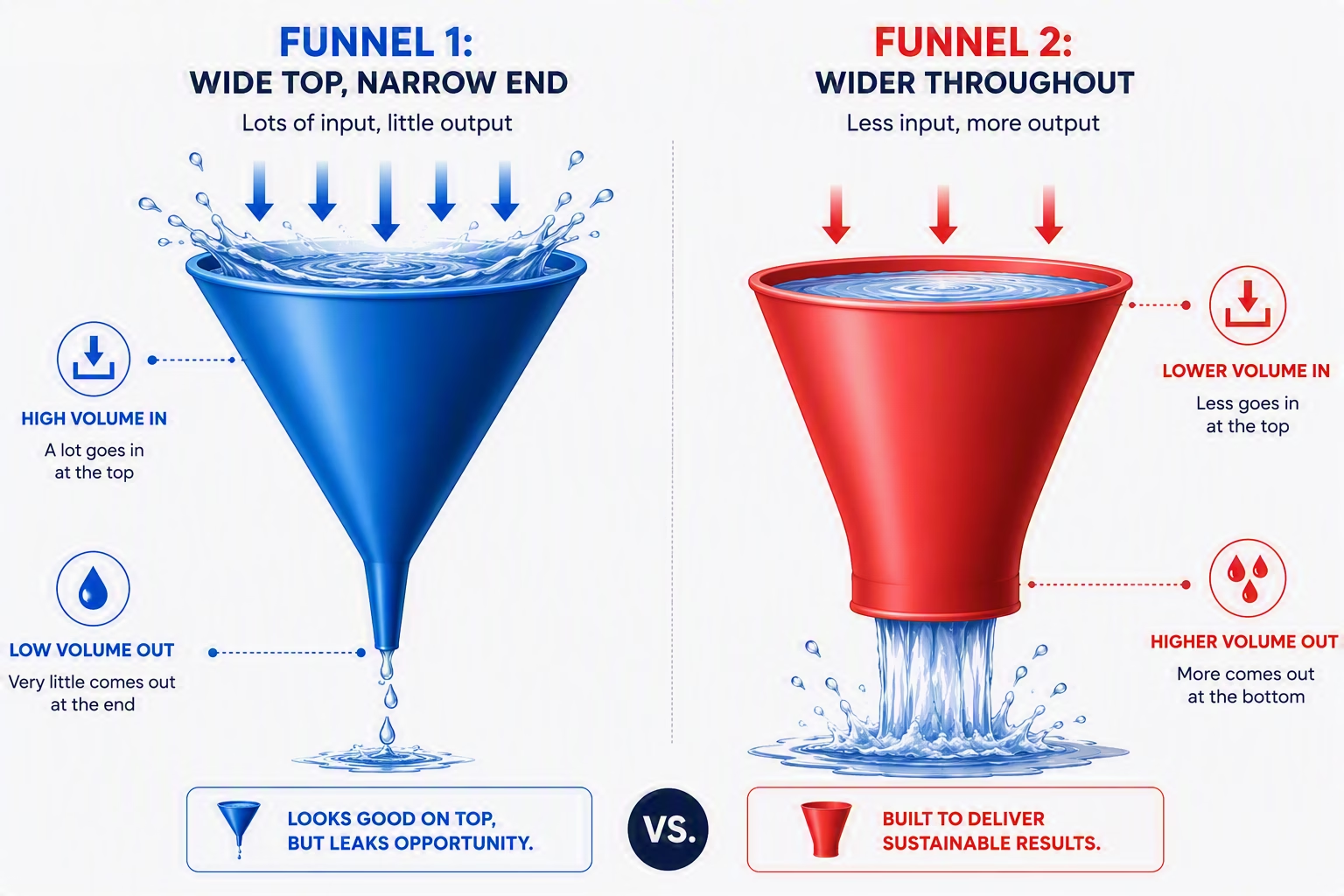
But here’s the reality of that ocean. Less than 10% of the people who could genuinely use your service are actually ready to buy right now. The other 90%? They’re out there… somewhere. Not ready. Not looking. Maybe not even aware they have a problem yet.
So you’re casting one worm into an enormous body of water; hoping to be in the right spot, at the right time, for the right fish. And the moment you stop throwing your bait into the ocean? You stop catching fish… just like your leads.
That’s not a criticism of paid ads. It’s just an honest description of what they are — and what they aren’t.
Paid Ads aside, you probably have your website, maybe a social channel or several, write blogs, maybe have some print documents like brochures. These are all dangling bait in the ocean waiting for a fish to catch.
Sometimes you are lucky sometimes you are not. And that’s the problem.
What First Nations Australians Figured Out Thousands of Years Ago
Now this is something I learnt from my daughter when she got home from school one day talking about what she learnt during one of the First Nations incursion sessions.
Long before modern marketing existed, First Nations Australians had already solved a version of this problem.
Rather than going out to hunt for fish every single day — expending energy, relying on luck, hoping the fish would be there — they did something far more clever. They engineered their environment.
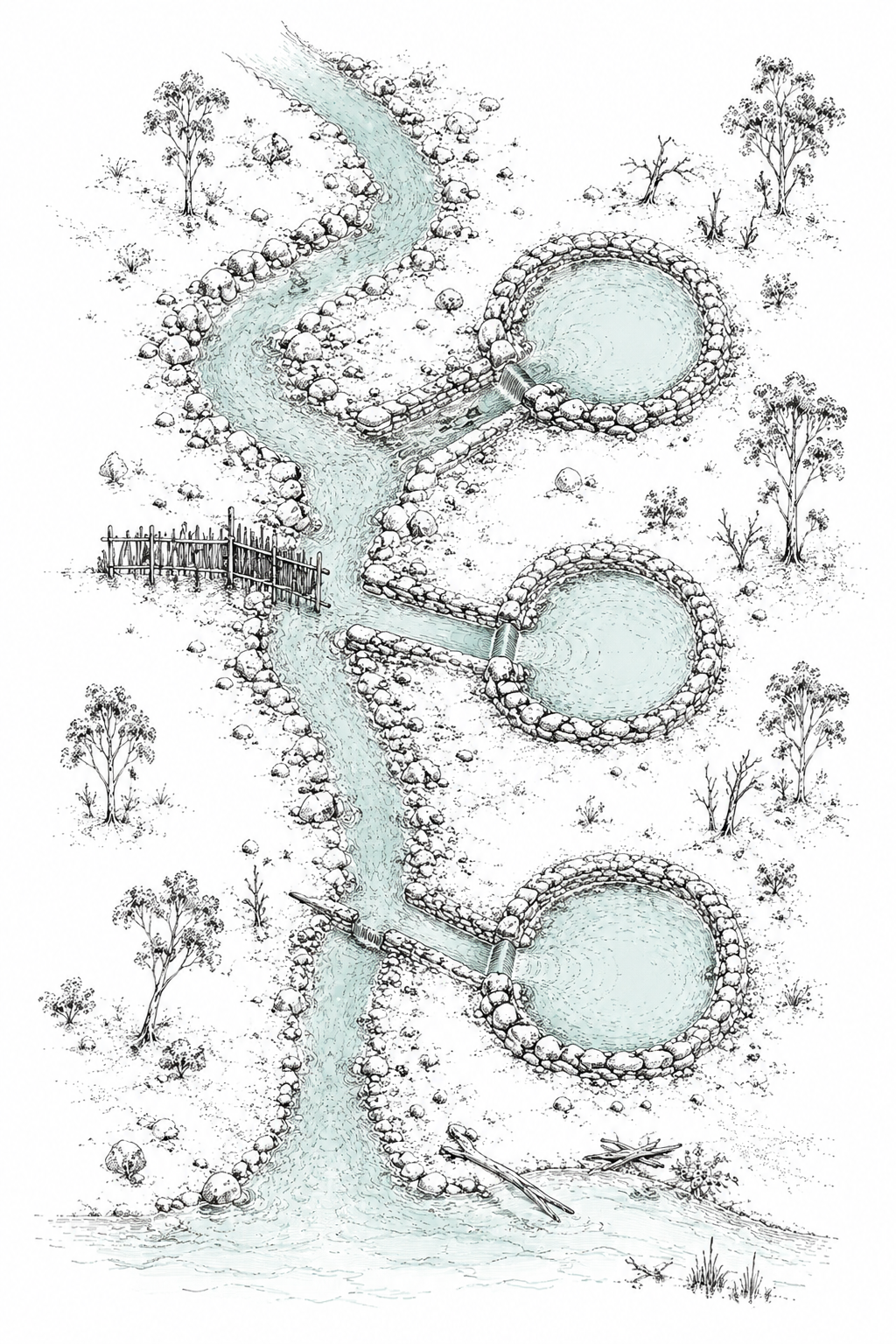
Using deep knowledge of water flows and fish or eel behaviour, they constructed elaborate networks of channels, weirs, and holding ponds. They shaped the river itself; directing the water — and the fish — toward a specific place. Once the fish arrived, they were guided into holding ponds where they could be nurtured, kept, and harvested when the time was right.
This wasn’t passive. It wasn’t patient waiting. It was active, intelligent system-building.
And it worked so well that some of these systems sustained entire communities for thousands of years — producing enough food not just to survive, but to trade.
Now. What has any of this got to do with your marketing pipeline?
Well… Everything.
Your Marketing Tools Might Already Be There. They’re Just Not Connected.
Here’s what I see in a lot of SME businesses.
The tools exist. The brochure exists. The website exists. Maybe there’s even a testimonial or two floating around somewhere. But they’re sitting in isolation; disconnected pieces that don’t lead anywhere.
A brochure gets handed to someone at a networking event. It’s glanced at, put in a bag, forgotten. End of journey.
A website gets visited once by someone who isn’t quite ready to buy yet. They leave. No next step. No reason to return.
An ad gets clicked by someone curious but unconvinced. They land on a page that doesn’t quite close the gap. They bounce.
This is the marketing equivalent of casting a net with giant holes in it.
The fish are entering the system. They’re just escaping before you catch them.
Shaping Your River
What if instead of chasing leads, you designed a system that channelled them toward you?
That’s the mindset shift most businesses are missing when using multiple channels for marketing.
Your brochure, your social posts, your ads, these are channels. They direct people. They create awareness. They generate initial interest. Think of them as the weirs and waterways that guide the fish in a particular direction.
Videos can play a part in all of these channels. They form part of the waterways.
But channels alone aren’t enough. You need a holding pond. A place where potential clients can sit, be nurtured, and grow warmer over time; without you having to personally chase every single one of them.
Here is where video really shines in the mix.
Not because video is better than print. It isn’t a competition. But because video does something that a brochure, or for that matter a website, fundamentally cannot… it creates emotional resonance.
It lets a potential client feel something. Hear a real voice. See a real face. Watch someone just like them describe a problem they recognise… and get a result they want.
That’s what keeps a lead in your pond.
A testimonial video linked from your brochure via a QR code. A case study video embedded in your email follow-up. An explainer video on a landing page that answers the exact objection stopping someone from taking the next step.
These aren’t replacements for your existing tools. They’re what can help tie the various tools together; and seals the leaks.
The Practical Version of This
Let me make it concrete.
Someone picks up your brochure at an event. You give out a business card while networking… they’re curious but not ready. The brochure or the card are like the weirs in the river — they stop them and direct them to go down a path.
It does its job — it reminds them you exist, it positions you credibly.
But at the bottom of the page, there’s a QR code. “See what our clients say.” They scan it. They watch a 90-second testimonial from a client who had exactly the same problem they have right now.
Suddenly, you’re not a brochure anymore. You’re a person. You’re a result. You’re a solution they can picture themselves using. They are swimming down the river exactly as you want them to… towards your holding pond.
They’re not ready to buy today. But they’re in your pond now.
And when they are ready — when that 10% moment arrives — they may dig through their desk drawer and find that brochure, or remember your website because of an emotional connection they created when they first saw it.
They already know, like, and trust you.
That’s not luck. That’s a system.
If you then tie in your Paid Ads as well, you will be like throwing your good bait into a small holding pond of hungry fish — which means the likelihood of the catch is much higher.
Anyone who has taken their kids to an inland fish farm for fishing will know what I’m talking about. It takes 5 minutes to catch a large Rainbow Trout.
So, What’s the Gap in Yours?
I’m not suggesting you tear up everything you’re already doing.
What I’m suggesting is this: take a good look at your existing marketing tools and ask yourself — where are the gaps? Where does the journey stop? Where does a potential client fall out of the system because there’s no next step, no emotional hook, no reason to stay?
Chances are, the answer isn’t more tools.
It’s better connections between the ones you already have.
And more often than not, a well-placed video is exactly what closes that gap.
If you’d like to talk through where video fits in your marketing system, I’m happy to have that conversation.